
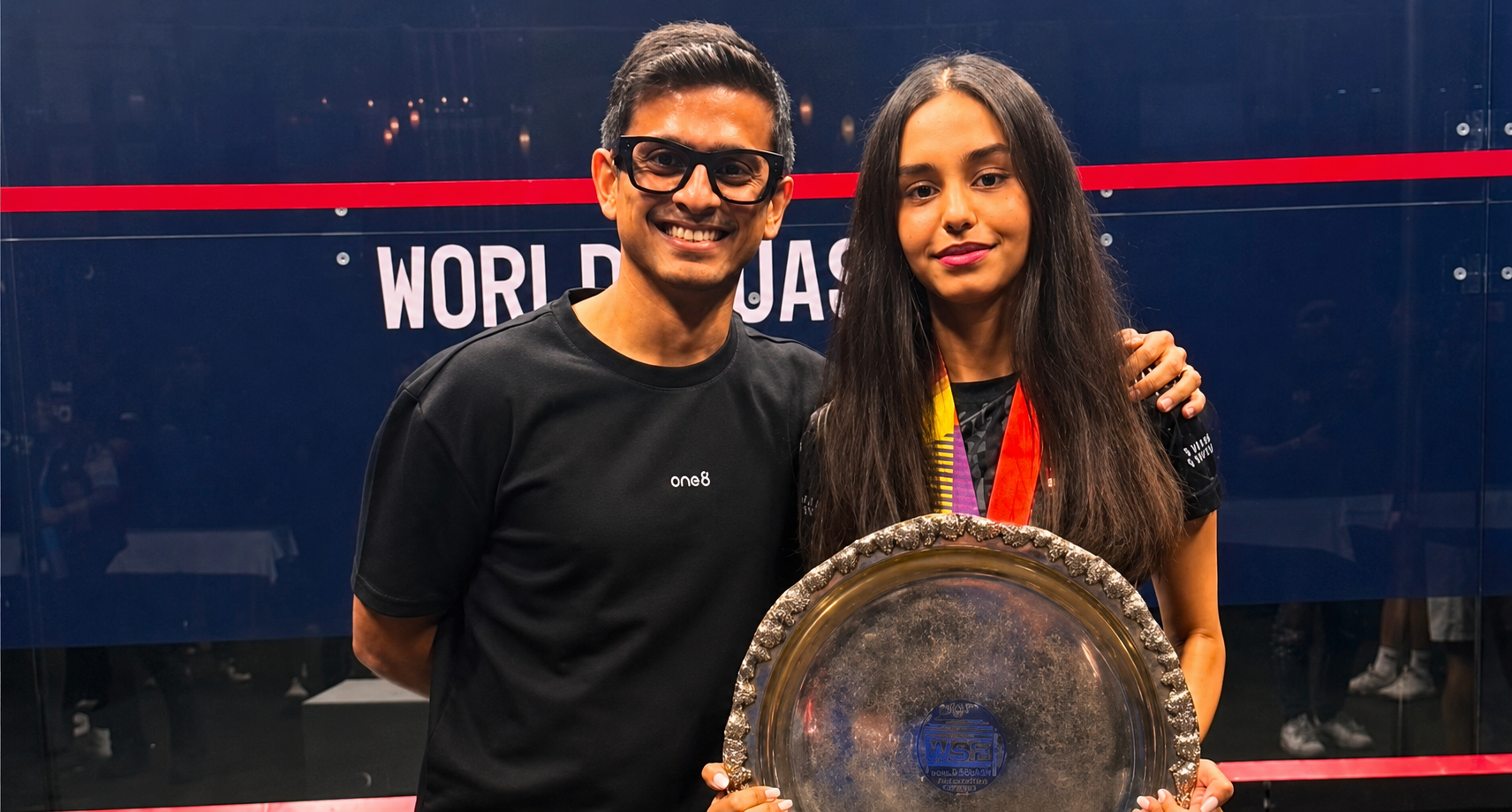
A Torch Passed, Not Just Handed Over
Indian squash has waited a long time for a moment like this. On a July evening in Niagara-on-the-Lake, Canada, an 18-year-old from New Delhi did something no Indian man or woman had ever done before. Anahat Singh won the World Squash Junior Championships, ending Egypt’s sixteen-year stranglehold on the girls’ title and becoming the first non-Egyptian ever to lift the trophy. It was a landmark result for a country that has produced fine squash talent for decades but never quite broken through at the very top of the junior game.
Standing quietly at the ringside, watching it unfold, was Saurav Ghosal, India’s most successful male squash player and, for the last year and a half, Anahat’s mentor. Their relationship isn’t built on formal contracts or a rigid training manual. Instead, as Ghosal describes it, it runs on humour, honesty, and the kind of tough love that only someone who has walked the same path can offer. This is the story of how that mentorship came together, what it actually looks like day to day, and why Ghosal believes Anahat’s victory is only the beginning of something much bigger for Indian squash.
Who Is Anahat Singh? The Making of a Champion
Born on 13 March 2008 in New Delhi, Anahat Singh turned professional in 2023 and has spent the years since climbing the world rankings at a startling pace. She has already won a gold medal at the Squash World Cup and two gold medals at the Asian Championships, but the World Junior title had eluded her until now. At just 18, she defeated Egypt’s second seed, Ruqayya Salem, in straight games in the final, a result that also made her the first Indian to even reach the World Junior final since Joshna Chinappa did so back in 2005, more than two decades earlier.
That statistic alone tells you how significant this win is. Squash’s junior circuit has been dominated by Egyptian players for the better part of two decades, producing a conveyor belt of champions who go on to rule the senior game as well. For an Indian teenager to break that pattern isn’t just a personal triumph; it’s a signal that the sport’s balance of power may be shifting, even if only slightly, and that India’s investment in grassroots and junior squash programs is beginning to pay dividends on the biggest stages.
Anahat currently sits at world No. 20 among seniors, with a career-best ranking of No. 18, remarkable numbers for someone who hasn’t yet finished school-age competition. She trains under a small but formidable support team: Saurav Ghosal, former world champion Grégory Gaultier, and coach Stéphane Galifi. It’s a setup that blends India’s own hard-won squash wisdom with elite European coaching, and it appears to be working exactly as intended.
Saurav Ghosal: The Mentor Who’s Been There Before
To understand why Ghosal’s mentorship matters so much, it helps to understand who he is. Ghosal is widely regarded as India’s greatest-ever male squash player. He became the first Indian to win the British Junior Open Under-19 title back in 2004, beating an Egyptian opponent in the final, an early sign, in hindsight, that Indian squash could compete with the sport’s traditional powerhouses. He went on to become national champion multiple times, won an Asian Games bronze medal, and was honoured with the Arjuna Award, becoming the first squash player from India to receive it.
In other words, Ghosal isn’t a coach parachuting in with theoretical knowledge. He has lived through every stage of the journey Anahat is now on the grind of junior competition, the pressure of being India’s best hope in a sport dominated by other nations, and the long climb up the senior world rankings. That lived experience is precisely what he brings to the mentorship, and it’s also what makes his voice carry so much weight with a teenager who is still finding her footing on the international stage.
Ghosal began working with Anahat in December 2024, and since then he and Gaultier have been present at nearly every major tournament she’s played. But Ghosal is careful to define his role precisely. He isn’t her primary technical coach; that responsibility belongs more to Gaultier, the former world champion who trains her intensively, including stints in Prague. Ghosal describes his own involvement as more sporadic and strategic: helping build her scheduling, shaping the broader ecosystem around her career, and stepping in as a mentor at key moments rather than a day-to-day technical guide. There is, by his own account, no formal contract between them — just an ongoing, informal commitment to help a hugely talented young player make the most of her ability.
The Mentorship in Practice: Humour, Honesty, and Tough Love
What makes this relationship distinctive isn’t just the tactical support; it’s the tone. Ghosal has spoken about using humour and even gentle mockery as tools to keep Anahat sharp mentally, joking about “hammering” her brain cells into working when it mattered most. That playful, needling style seems designed to cut through the nerves and self-doubt that can creep in before a career-defining match, replacing pressure with a kind of relaxed confidence.
But alongside the humour sits an unmistakable honesty. Ghosal isn’t known for handing out praise lightly, and after Anahat’s title-winning performance, he made a point of noting that this was something he doesn’t say often. That restraint is itself part of the mentorship style: when the praise does come, it means something, precisely because it isn’t handed out as a matter of routine. In his message to her after the final, he was careful to separate the outcome from the process, pointing out that the real battle had already been won in the weeks and months of preparation before she ever stepped onto the court in Canada. The result, in his framing, was simply the visible proof of invisible work.
This is where the “tough love” element comes in. Ghosal’s mentorship doesn’t appear to coddle or over-praise. Instead, it holds Anahat accountable to a standard of consistent effort, reserving genuine celebration for moments that truly warrant it, while making sure she understands that titles are earned in training gyms and practice courts long before they’re claimed under tournament lights.
Why This Story Resonates Beyond Squash
There’s something universally relatable about this mentor-mentee dynamic, even for readers who’ve never picked up a squash racquet. It echoes a familiar and comforting narrative: the senior professional who has already climbed the mountain, choosing to guide a younger talent up the same path, not out of obligation, but because they see something special worth nurturing. It’s the kind of story that resonates with anyone who has had a teacher, senior colleague, or older sibling figure who pushed them harder precisely because they believed in them.
It also lands at a broader moment for Indian sport, where mentorship structures, senior athletes formally or informally guiding the next generation, are increasingly recognised as critical to sustained success, rather than one-off breakthroughs. India has often struggled to convert individual brilliance into a steady pipeline of champions. Stories like Ghosal and Anahat’s suggest a template where established stars stay involved in the sport not just as competitors but as builders of what comes after them.
What’s Next: Asian Games and an Olympic Dream
The scale of what Anahat has achieved is matched by the scale of what she’s aiming for next. Squash has been added to the Olympic programme for the first time, with its debut set for the 2028 Los Angeles Games, an opportunity that Anahat has described as one squash players never thought they’d actually get. Her immediate target is the Asian Games in Japan this September-October, where a gold medal could offer a direct route to Olympic qualification.
Ghosal, for his part, is visibly excited about the prospect, noting that Anahat is riding high in confidence and belief in herself, backed by a support system that includes Gaultier’s technical expertise and his own mentorship on the broader picture. If she falls short at the Asian Games, Anahat has said there remain other pathways to qualification, a sign of the calm, methodical approach that seems to run through both her mindset and her mentor’s guidance.
For Ghosal, this moment is also deeply personal. He has spent much of his career as the lone flag-bearer for Indian men’s squash on the world stage. Watching a player he’s guided become India’s first World Junior champion, and potentially open the door to India’s first Olympic squash representation, represents a kind of legacy that goes beyond his own playing career. It’s the moment where an individual champion becomes part of something structural: a program, a pathway, a proof of concept for the next generation of Indian squash players who might now believe an Olympic medal isn’t a fantasy.
The Bigger Picture for Indian Squash
Anahat Singh’s triumph doesn’t exist in isolation. Indian squash has quietly built strength in depth over the past two decades, through players like Joshna Chinappa, Dipika Pallikal, and Ghosal himself, even without the headline global titles that dominant nations like Egypt have collected. What’s changed now is that a teenager has broken through at the junior level in a way that suggests this depth is finally translating into world-beating results at the youngest levels of competition, not just the senior circuit.
That matters because junior success is often the clearest predictor of senior dominance. Egypt’s stranglehold on the World Junior Championships for sixteen years directly mirrored its dominance in the senior professional rankings during the same period. If Anahat’s win is the start of a genuine shift rather than a one-off outlier, it could signal a changing of the guard in world squash over the coming decade, with India positioned, for the first time, as a serious contender rather than a plucky underdog.
This is also a story about infrastructure catching up with ambition. For years, Indian squash administrators and former players have spoken about the need for better academies, more international exposure for juniors, and mentorship pipelines that connect established professionals with rising talent. Anahat’s setup- training partly abroad in Prague, guided by a former world champion, and backed by a senior Indian pro who understands exactly what it takes to compete on the global stage looks like an early example of that vision actually being executed rather than just discussed. If other young Indian players and their families can replicate even part of this model, the country’s squash pipeline could look very different a decade from now.
What Aspiring Young Athletes Can Learn From This Story
Beyond the headlines and medal counts, there’s a broader lesson here for young athletes across any sport, not just squash. The Ghosal-Anahat partnership demonstrates that talent alone rarely wins world titles; it needs structure, honest feedback, and someone who has already navigated the same pressures to help translate raw ability into consistent performance under scrutiny.
It also shows the value of separating roles clearly. Anahat’s team isn’t one person trying to do everything; it’s a coach for technical development, a mentor for the bigger picture, and the athlete herself staying accountable to both. That division of labour, rather than relying on a single all-purpose figure, may be one of the more quietly important takeaways from this entire story, a model worth studying for parents, coaches, and sports federations trying to build the next generation of Indian champions.
A Mentor’s Quiet Triumph
Saurav Ghosal’s role in Anahat Singh’s rise offers a rare, honest glimpse into what effective mentorship actually looks like in elite sport. It isn’t about micromanaging every stroke or hovering anxiously courtside. It’s about building the right ecosystem, choosing when to push and when to step back, using humour to defuse pressure, and reserving genuine praise for the moments that truly earn it. Ghosal describes his role modestly: sporadic involvement, no formal contract, mentorship rather than coaching, but the results speak for themselves.
As Anahat Singh turns her attention to the Asian Games and, beyond that, a potential Olympic debut in Los Angeles 2028, the partnership between her and Ghosal looks set to remain one of the more compelling storylines in Indian sport. It’s a reminder that behind every historic individual achievement, there is often a quieter story of guidance, trust, and the kind of tough love that only someone who has been there before can truly offer.
Also Read: India’s Biodiversity Hotspots: A Deep SWOT Analysis
Frequently Asked Questions
Who is Anahat Singh’s mentor? Anahat Singh is mentored by Saurav Ghosal, India’s most decorated male squash player, while her technical coaching is led by Grégory Gaultier, a former world champion, alongside coach Stéphane Galifi.
What did Anahat Singh achieve at the World Junior Squash Championships? She became the first Indian and the first non-Egyptian in 16 years to win the World Squash Junior Championships title, defeating Egypt’s Ruqayya Salem in the final.
What is Anahat Singh’s next big goal? She is targeting a strong showing at the Asian Games in Japan this September-October, with an eye on qualifying directly for the 2028 Los Angeles Olympics, where squash will make its Olympic debut.


