

India’s Information Technology sector stands as one of the most significant success stories in the country’s economic development over the past two decades. Examining the performance of this critical industry under two different political leaderships (BJP vs Congress) – the Congress-led United Progressive Alliance (UPA) from 2004-2014 and the Bharatiya Janata Party-led National Democratic Alliance (NDA) from 2014-2024 – reveals distinct approaches, achievements, and challenges that have shaped the sector’s trajectory.
The analysis shows that while both governments contributed significantly to IT sector growth, their strategies, contexts, and outcomes differed markedly. The UPA period was characterized by explosive foundational growth and policy establishment, while the NDA era focused on digital transformation, startup ecosystem development, and advanced technology integration.

Foundation Era: UPA’s IT Sector Development (2004-2014)
Explosive Growth from Low Base
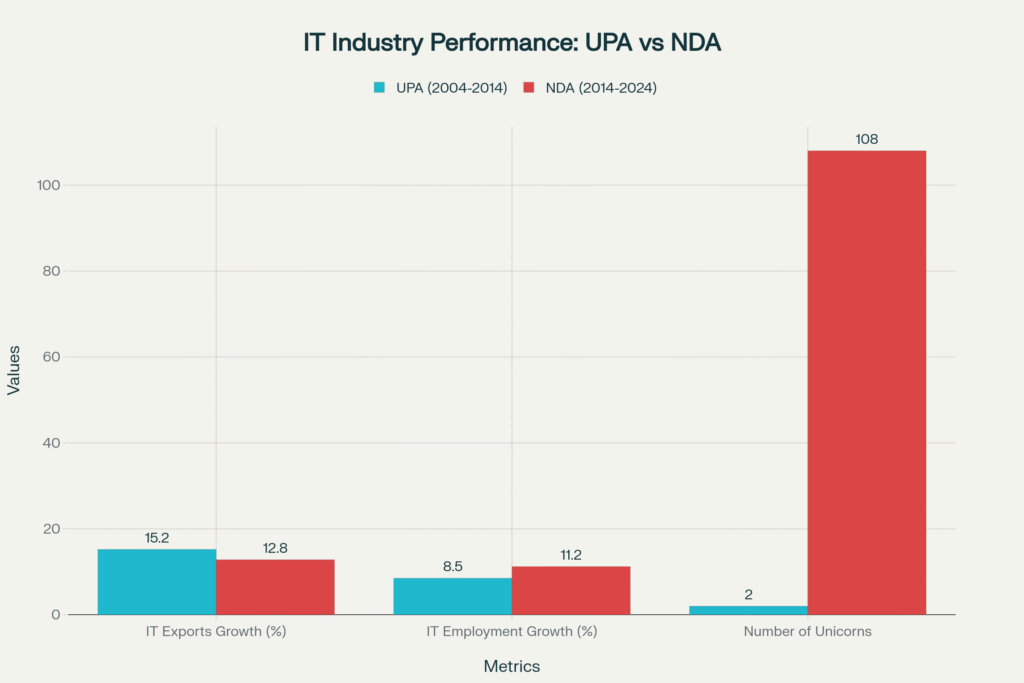
The UPA period witnessed unprecedented growth in India’s IT sector, with software exports expanding from $12.8 billion in 2004 to $82.5 billion in 2014 – representing a remarkable 544% total growth over the decade. This exponential expansion occurred during the sector’s foundational phase, when India was establishing itself as the world’s back office and software development hub.
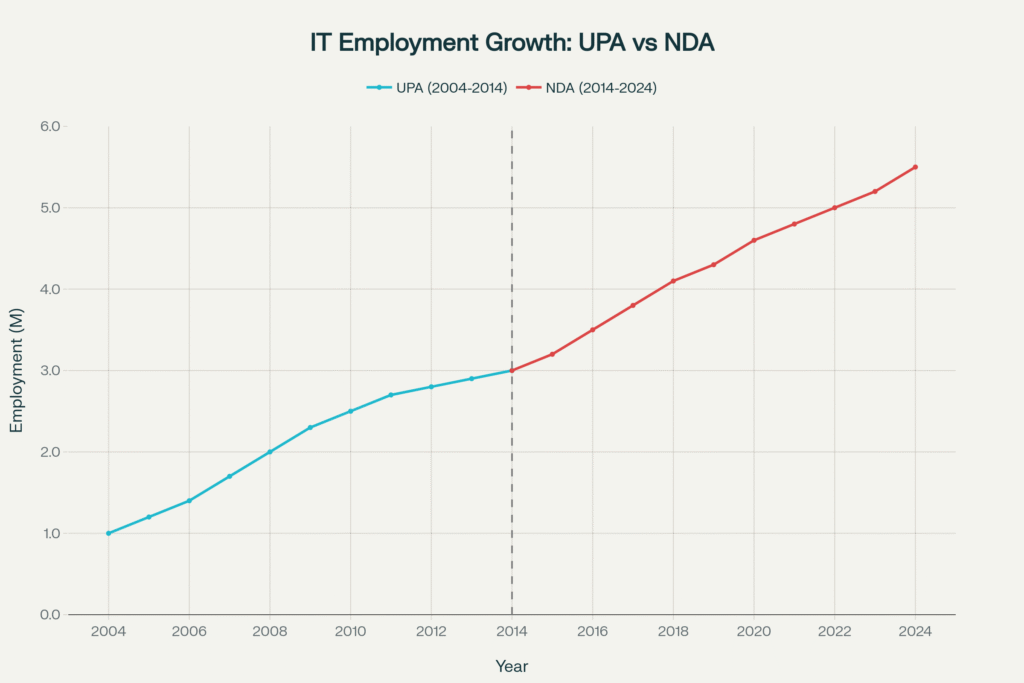
Employment in the IT sector demonstrated equally impressive growth, increasing from 1 million professionals in 2004 to 4 million by 2014 – a 300% expansion that created substantial middle-class employment opportunities. This growth occurred alongside robust overall economic performance, with India achieving an average GDP growth rate of 6.8% annually during the UPA tenure.
Policy Framework and Infrastructure Development
The UPA government’s approach centered on liberalization and creating an enabling environment for IT services exports. The establishment and expansion of Software Technology Parks of India (STPI) provided critical infrastructure and regulatory support for emerging IT companies. The government maintained a 100% Foreign Direct Investment (FDI) policy for the IT sector, attracting significant international investment.
During this period, basic e-governance initiatives were launched, laying the groundwork for digital government services. The UPA also initiated the National e-Governance Plan, which would later be rebranded and expanded under the NDA government. However, policy implementation often faced bureaucratic delays, with the National Manufacturing Policy remaining largely on paper without significant actionable outcomes.
Economic Context and Global Positioning
The UPA period benefited from favorable global economic conditions, particularly before the 2008 financial crisis. India’s position as a cost-effective outsourcing destination was solidified during this era, with major multinational corporations establishing significant operations in Indian cities. The focus remained primarily on traditional IT services including software development, maintenance, and business process outsourcing.
Transformation Era: NDA’s Digital India Vision (2014-2024)
Mature Market Growth and Digital Innovation
The NDA period saw the IT sector evolving from traditional services to advanced digital solutions. Software exports grew from $108 billion in 2014 to $224 billion in 2024, representing a 107% increase. While the percentage growth was lower than the UPA period, this expansion occurred from a much higher base and during challenging global economic conditions including the COVID-19 pandemic.
Employment growth continued steadily, reaching 5.5 million professionals by 2024 from 4.1 million in 2014. The BJP government claims creation of 8.73 lakh new IT jobs during its tenure, supported by NASSCOM data. However, this growth rate of 34% was significantly lower than the UPA period, reflecting the sector’s maturation and automation trends.
Digital India and Technology Transformation
The NDA government’s flagship Digital India initiative, launched in 2015, fundamentally transformed the sector’s approach from services-focused to solution-oriented development. Key achievements include:
Financial Innovation: The Unified Payments Interface (UPI) revolution made India a global leader in digital payments, with UPI capturing 55% of global real-time payment transactions. The JAM (Jan Dhan-Aadhaar-Mobile) trinity enabled financial inclusion for over 500 million previously unbanked citizens.
Startup Ecosystem Development: India emerged as the world’s third-largest startup ecosystem with 1.59 lakh DPIIT-recognized startups and 117 unicorns by 2024. The Startup India initiative created a supportive framework for innovation and entrepreneurship.
Advanced Technology Integration: The government launched the IndiaAI Mission with a ₹10,300 crore allocation, establishing one of the world’s largest AI compute infrastructures with 18,693 GPUs. Centers of Excellence were established for emerging technologies including IoT, blockchain, and artificial intelligence.
Infrastructure and Policy Reforms
The NDA period witnessed significant infrastructure investment increases. Capital expenditure as a proportion of total government spending rose to over 21% in 2023-24, compared to just 12% in 2013-14 under the UPA. The government expanded STPI facilities to 67 centers, with 59 located in Tier II and III cities to promote inclusive growth.
However, the Make in India initiative faced challenges, with manufacturing’s share in GDP declining to 13% by 2023-24 from 16% during the UPA era. Critics argue that despite extensive branding, manufacturing growth did not meet stated objectives.
Comparative Analysis: Strengths and Challenges
Economic Performance Metrics
Growth Trajectories: The UPA period demonstrated higher percentage growth rates due to the low base effect, while the NDA period showed substantial absolute growth despite lower percentage increases. The UPA’s average annual GDP growth of 6.8% marginally exceeded the NDA’s 6.6%, though the latter was impacted by global challenges including the pandemic.
Export Performance: Both periods achieved significant export growth, with the UPA establishing India’s global position and the NDA diversifying into high-value services. Total IT industry revenue increased from $118 billion in 2014-15 to $283 billion in 2024-25 under NDA leadership.
Employment Generation: The UPA created 2.9 crore jobs across all sectors from 2004-2014, while the NDA generated 17.19 crore jobs from 2014-2024. However, manufacturing employment growth was higher under the NDA (15%) compared to the UPA (6%).
Policy Innovation and Implementation
Digital Transformation: The NDA government’s digital initiatives showed greater sophistication and integration compared to UPA’s foundational e-governance efforts. UPI’s success exemplifies effective policy-to-implementation conversion that was often lacking during the UPA era.
Regulatory Framework: The UPA maintained a more hands-off approach, while the NDA implemented comprehensive policy frameworks including the Digital Personal Data Protection Act and AI governance guidelines. However, recent AI regulation attempts faced criticism for potentially stifling innovation.
Infrastructure Development: The NDA demonstrated superior infrastructure implementation with 4x higher capital expenditure compared to the UPA. Road construction, telecommunications infrastructure, and digital connectivity showed marked improvement.
Current Challenges and Future Outlook
Both governments faced distinct challenges reflecting their respective eras. The UPA dealt with corruption scandals and policy paralysis in its later years, while the NDA faces contemporary issues including:
Talent and Skills Gap: The industry confronts significant skill shortages in emerging technologies, with cloud computing requiring 3.9 million professionals but only 1.5 million available. Cybersecurity roles face a 700,000 professional deficit.
Global Competition and Geopolitical Risks: Recent U.S. policy changes, including the $100,000 H-1B visa fee implementation, highlight ongoing challenges for Indian IT professionals. Opposition parties have criticized the government’s diplomatic response to these developments.
Economic Headwinds: The IT sector faces margin pressures with employee costs increasing by 206% while revenue grew by 185% over the past decade. Average employee costs now represent 57% of revenue.
Technology Evolution: While India leads in traditional IT services, competition in emerging technologies like AI, quantum computing, and advanced manufacturing remains intense.
Conclusion
The comparative analysis reveals that both the UPA and NDA governments contributed significantly to India’s IT sector development, albeit through different approaches suited to their respective eras. The UPA period was characterized by foundational growth, policy liberalization, and establishing India’s global outsourcing leadership. This era’s 544% export growth and 300% employment expansion created the foundation for India’s current IT prominence.
The NDA period focused on digital transformation, advanced technology integration, and comprehensive policy frameworks. While growth rates were lower due to the higher base, the absolute value creation was substantial, with IT revenue reaching $283 billion by 2024. The development of the startup ecosystem, digital payment infrastructure, and AI capabilities positioned India for future technology leadership.
Both governments faced criticism – the UPA for policy paralysis and corruption in later years, the NDA for manufacturing sector challenges and recent diplomatic setbacks regarding H-1B visas. However, the overall trajectory shows consistent IT sector growth across both administrations, suggesting that India’s IT success transcends political boundaries while benefiting from different strategic emphases during different developmental phases.
Looking forward, the sector’s success will depend on addressing skill gaps, maintaining global competitiveness, and navigating geopolitical challenges while leveraging India’s strengths in digital innovation and technology services. The foundation built during the UPA era and the digital transformation achieved during the NDA period provide a robust platform for continued growth in the global technology landscape.
Also Read: Growth of the Indian Medical Device Industry


